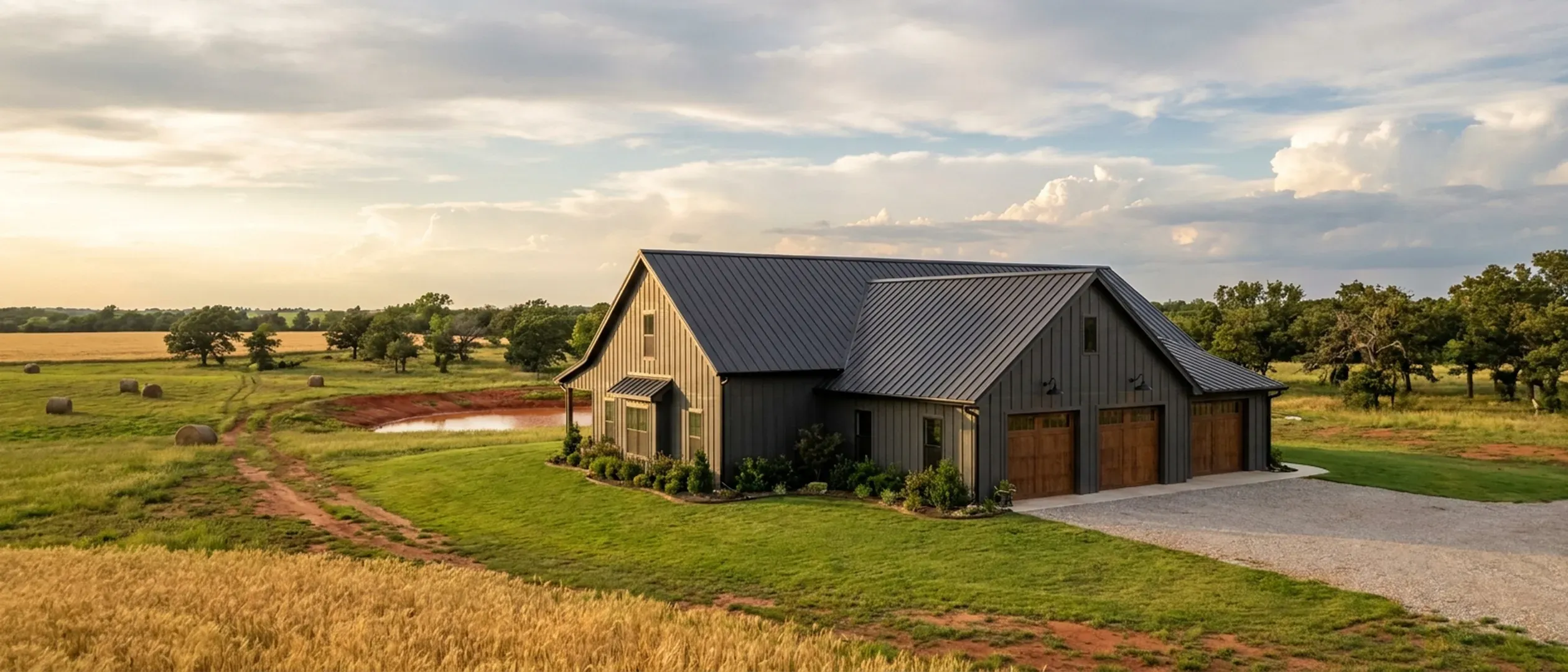
Are Barndominiums Legal in Oklahoma? Codes, County Permits, Septic and Trade Licensing
Yes. Oklahoma's rules are written around what a building is used for, not what it is clad in, and a barndominium lived in as a home is a one- or two-family dwelling like any other. The harder question is which rules apply on your land and who checks them. The State adopts one minimum residential code for the whole state, but it leaves enforcement to cities, counties and other local jurisdictions, and counties only have planning and building-code powers under specific State acts. Septic systems are a State matter everywhere, through the Department of Environmental Quality, and plumbing, electrical and mechanical work is a licensed trade statewide. This page sets out each layer with its source, and what to ask locally. It is general information, not legal advice for a particular parcel.
Figures on this page are cited third-party or government data, not a quote from Oklahoma Barndominium Builders.
Bottom Line Up Front
- Oklahoma adopts a statewide minimum residential code, the 2024 International Residential Code with Oklahoma amendments, effective 14 September 2026. It is enforced by local jurisdictions, not by a State building inspector.
- Whether you need a building permit depends on the city or county. Counties have zoning and building-code powers only under specific State planning acts, so the answer in unincorporated areas varies county by county.
- Septic systems need a DEQ Authorization to Construct anywhere in the state, and plumbing, electrical and mechanical work is done by trade contractors licensed through the Construction Industries Board.
What the State sets, and what it leaves to your jurisdiction
The State's residential code rule is specific about which figures it fills in and which it leaves to the local jurisdiction.
Design figures come from the jurisdiction
OAC 748:20-6-8 leaves the frost line depth, the design wind speed and the ground snow load in the IRC's climatic design table for the jurisdiction to fill in. A kit manufacturer should design the frame to the figures your building department uses; where no department sets any, ask what the frame was designed for and get it in writing.
An optional tornado appendix
The adopted code includes Appendix BR, Residential Tornado Provisions, with prescriptive requirements aimed at a 135 mph wind event, corresponding to an EF-2 tornado. Under OAC 748:20-6-53 it is not mandatory unless a jurisdiction's adopting ordinance or order specifically references it, so ask whether yours has.
Storm shelters: not required, but built to a standard if built
No provision of the State's residential code rule requires a new house to include a storm shelter. If one is built, the rule's amended Section R307.3 says it must be constructed to ICC 500, with a minimum shelter design wind speed of 250 mph statewide, and an in-ground shelter in a garage floor must have its rim at least 1 inch above the adjacent floor. Those figures are for the shelter, not for the house around it.
An amended energy chapter
The State rule amends the IRC's energy chapter, so insulation and window values published for the national code are not necessarily the Oklahoma values. Your building department applies the amended version.
Septic, wells and shop drains
Most barndominiums are built on land without city sewer, which makes the septic system a State approval on the critical path.
Soil first
DEQ describes a soil profile test as a minimum of three holes or pits dug in the dispersal area, and says the soil results determine which systems are allowed, from a conventional subsurface system to an aerobic system with spray or drip irrigation or a lagoon. Percolation tests may only be used to identify sites for conventional subsurface systems.
Sizing by bedrooms
OAC 252:641 bases a home system's average daily flow on 200 gallons per day for a residence of two bedrooms or less, plus 66 gallons per day for each additional bedroom. That is why the bedroom count needs to be settled before the septic system is designed.
Shop wastewater is not household sewage
OAC 252:641 defines sewage as wastewater from toilets, washing, bathing, food preparation and laundry, excluding industrial wastewater. A residential septic system is designed for household sewage, so plan any shop floor drain separately.
Private wells
Under 82 O.S. § 1020.3 a landowner may take groundwater for domestic use without a permit. Under § 1020.16 commercial water well drillers and pump installers must be licensed with the Oklahoma Water Resources Board.
Plans, titles and who draws them
Oklahoma restricts professional titles closely, which shapes how any builder can describe its design work.
No architect required for most houses
59 O.S. § 46.21b lists the construction of a building no more than two stories in height in residential Code Use Groups R3 and R4 among the work the architects' act does not reach, with a basement not counted as a story. A one- or two-story barndominium can be designed without a licensed architect, although your building department may still ask for engineering on the frame.
The titles themselves are protected
59 O.S. § 46.8a makes it unlawful to use the title architect or architectural designer, or advertising indicating that a person is an architect, without a licence, and 59 O.S. § 475.1 does the same for engineer and surveyor titles. When those words appear on this site, they describe third-party licensed professionals, such as the engineer who seals a manufacturer's frame drawings where a building department requires it.
What to ask before you apply
Five questions settle most of the legal picture for a specific parcel.
Is the land inside a city's limits?
If so, the city's permit office, zoning code and adopted codes apply. Ask which code edition it enforces and whether it has adopted the tornado appendix or its own amendments.
If not, does the county issue residential permits or zone?
Ask the county which planning act it operates under, whether it issues residential building permits, and whether any farm-home or acreage provision applies to your parcel. Get the answer from the county, in writing where you can.
Where will the septic system go?
Arrange the soil test early. The result decides the system type, and the system type can decide where the house goes on the lot.
Who inspects the trades?
Where there is no local inspector for plumbing, electrical or mechanical work, the Construction Industries Board is the enforcing body and notice of the work goes to it.
Are there private restrictions?
Deed restrictions, subdivision covenants and easements can limit building type, size or siting regardless of public rules. Read the title documents before you buy.
Reading this because you are weighing a build? The next step is a plan drawn for your program.
What's different about Oklahoma
One statewide minimum code
Under 59 O.S. § 1000.23 the Oklahoma Uniform Building Code Commission adopts the codes for residential construction, and those codes are the minimum standards in the state. Cities and other political subdivisions must abide by them but may enact higher standards, and under § 1000.29 local amendments need the Commission's approval. The Commission's current rule, OAC 748:20-6, adopts the 2024 International Residential Code as amended as the statewide minimum code for one- and two-family dwellings and townhouses, effective 14 September 2026. The 2018 edition was the minimum before that date, so a city's own pages may still show 2018 for a while.
Enforcement is local
The Commission's own FAQ says local jurisdictions, municipalities and other political subdivisions interpret and enforce the minimum codes, and that in unincorporated areas the Construction Industries Board enforces the electrical, mechanical, plumbing and fuel gas codes. It names no State agency that inspects the structure of a house in unincorporated areas. In practice, whether anyone reviews the plans and inspects the framing depends on the city or county the land is in.
Counties plan and zone only under specific State acts
Title 19 gives Oklahoma counties planning, zoning and building-code powers through separate acts, each with its own conditions: some apply only to counties of a certain population or with a large city, one requires a countywide vote to create a county planning commission, and one reaches mainly the areas near a city, highways and city reservoirs. Some counties therefore issue residential building permits in unincorporated areas and many do not. The only reliable answer for a given parcel comes from the county itself.
Farm buildings and farm homes: the wording differs by act
Several of those county acts say their zoning powers do not apply to the usual farm buildings for agricultural purposes. Two go further for farm homes: under 19 O.S. § 863.25 no fees or permits are required for the construction of any farm home, and under § 865.61 a county planning commission's rules do not apply to the erection of farm homes. Under § 866.30 a county's building-code power under that act does not reach a single-family residence on a separate parcel of land under one ownership containing 20 acres or more. Each of those applies only in counties acting under that particular act, and none defines a farm home. A barndominium is a residence; whether it counts as a farm home is a question for the county, not an assumption to design around.
Septic systems are a State approval everywhere
The Oklahoma Department of Environmental Quality says an Authorization to Construct must be purchased and issued by DEQ before a new on-site sewage system is installed, and describes three steps: a report for on-site sewage, the Authorization to Construct, and inspections. The soil test results decide which kinds of system are allowed. Soil profile tests may only be done by DEQ or a DEQ-certified soil profiler. Since 1 November 2025, DEQ says a person not certified by DEQ may install only one system per calendar year, and a system installed by a non-certified installer must be inspected by DEQ.
Trade licensing, and no general contractor licence
The Construction Industries Board's FAQ says general contractors are not currently required to have a state licence in Oklahoma, and that the Board regulates plumbing, electrical and mechanical trades among others. It also says the Board does not issue permits for specific work, and that where a city or town has not adopted a State-recognised code or has no inspector for a trade, notice of plumbing, electrical or mechanical work must be given to the Board. On a barndominium, licensed trade contractors handle plumbing, electrical and HVAC wherever the land is.
Pros and cons, honestly
Pros
- One statewide minimum residential code, so the technical rules are the same everywhere even where enforcement differs.
- A barndominium used as a home is treated as a dwelling, not as a special category.
- One State agency, DEQ, handles septic authorizations across the state.
- No architect is required for a residence of up to two stories.
Cons
- Whether anyone reviews plans or inspects the structure depends on the city or county, and varies widely in unincorporated areas.
- County farm-home and acreage provisions exist only under particular State acts, so they cannot be assumed.
- Design wind, snow and frost figures come from the jurisdiction, and some rural areas publish none.
- The code edition changed on 14 September 2026, so local pages may lag behind the State rule.
- Septic approval depends on the soil, which can decide the system type and where the house goes.
Are barndominiums legal in Oklahoma?
Do I need a building permit for a barndominium in Oklahoma?
What building code applies in Oklahoma?
Is a barndominium on farmland free of permits in Oklahoma?
Do I need a septic permit?
Do I need a permit to drill a household well?
Must a new home in Oklahoma include a storm shelter?
Do I need an architect to design a barndominium?
Does my builder need a state licence?
Questions answered? Tell us what you want to build and we will put real numbers against it.
Sources
- Oklahoma Statutes, Title 59 (official complete title) — §§ 1000.23, 1000.29 (OUBCC), 46.8a and 46.21b (architects), 475.1 (engineers and surveyors)
- Oklahoma Statutes, Title 19 (official complete title) — county planning acts §§ 863, 865, 866, 868
- Oklahoma Statutes, Title 82 (official complete title) — §§ 1020.3, 1020.16 (groundwater, well drillers)
- Oklahoma Uniform Building Code Commission — International Residential Code adoptions
- OUBCC — OAC 748:20-6, 2024 IRC permanent rule (effective 14 Sep 2026)
- Oklahoma Uniform Building Code Commission — FAQs
- Oklahoma Construction Industries Board — Frequently Asked Questions
- Oklahoma Department of Environmental Quality — Sewage Treatment (on-site systems)
- Oklahoma DEQ — FAQs for installer changes effective 1 November 2025
- Oklahoma DEQ — OAC 252:641, Individual and Small Public On-Site Sewage Treatment Systems
Keep reading
The pages that answer the next question this one raises.
Permitting
How the permit, septic and inspection steps fit into a build.
Read itBuild timeline
Where local approvals and the septic system sit in the schedule.
Read itBarndominium pros and cons
Tornadoes, hail, clay soils and appraisal in Oklahoma.
Read itSite preparation
Clearing, grading and the building pad once approvals are in hand.
Read itService areas
Local permit and septic facts for the cities and counties we serve.
Read itStart the survey
Tell us where your land is and what you plan to build.
Read itWant a real number instead of a range?
Start the survey and tell us about your land and what you want to build. Include the county and parcel ID if you have them, because in Oklahoma the jurisdiction, the soil and the well and septic answers change the budget more than the building does. The survey costs nothing.