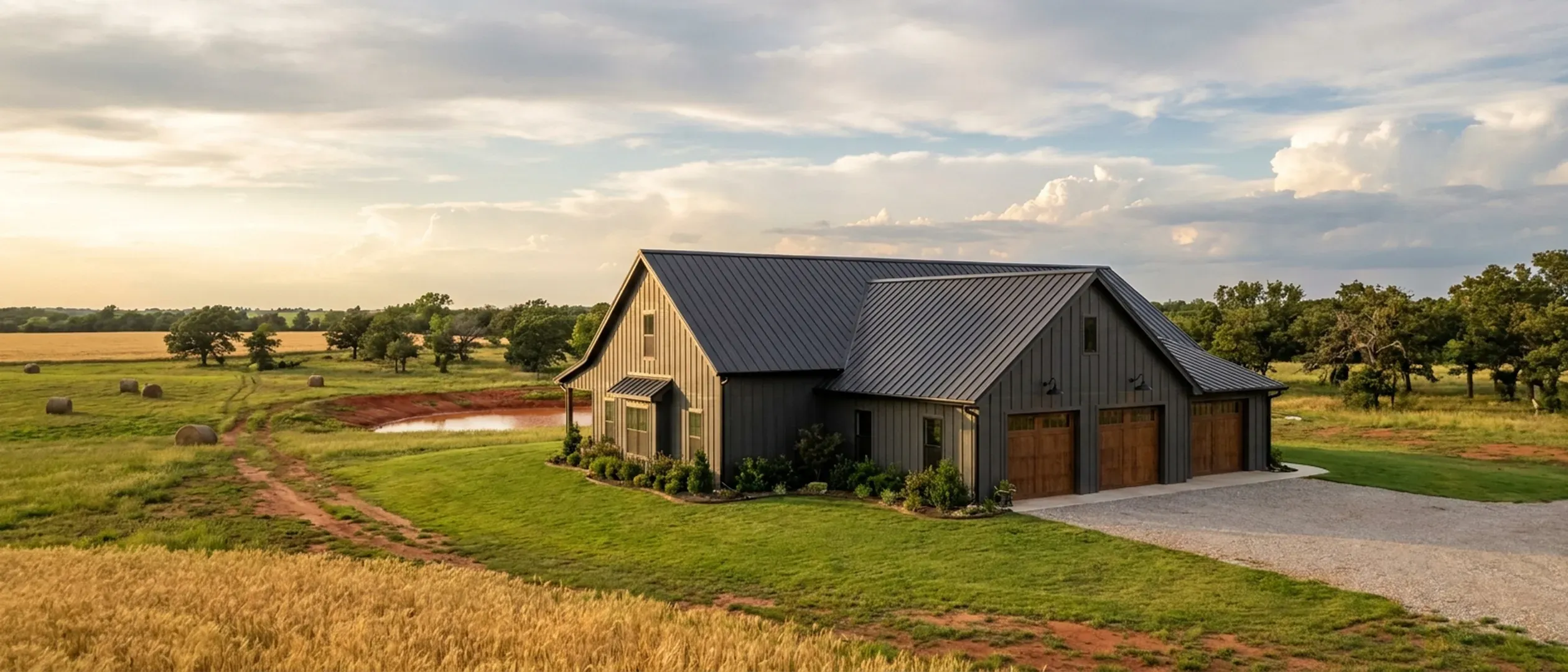
Are Barndominiums Worth It in Oklahoma? Land, Appraisal, Insurance and Resale
Whether a barndominium is worth it is not a question about metal buildings in general. It is a question about what you need the building to do, the land you will put it on, and how a lender, an insurer and an eventual buyer will see it. In Oklahoma a few of those answers are local: hail is the most common homeowners claim according to the Oklahoma Insurance Department, a spring tornado season shapes both insurance and the case for a safe room, and a lot of the land people build barndominiums on is rural acreage with its own water, fire-protection and appraisal questions. This page sets out when the answer is usually yes, when it is usually no, and what to check before you decide. It names its sources, and it does not quote our own prices; cost figures are in the cost guide, each with its source.
Figures on this page are cited third-party or government data, not a quote from Oklahoma Barndominium Builders.
Bottom Line Up Front
- A barndominium is most clearly worth it when you need a large shop, equipment bay or garage anyway and want it under the same roof and on the same foundation as the house.
- It is least clearly worth it when you want a conventional house on a suburban lot, plan to sell within a few years, or will need a loan on land where there are few comparable sales.
- In Oklahoma, check four things before deciding: how an insurer will treat hail on the roof, where a safe room goes, what the soil under the slab does, and what a lender's appraiser will compare the house to.
When a barndominium is usually worth it
The strongest cases have something in common: the building is doing two jobs, or the land makes a conventional house awkward.
You need the shop anyway
If the plan already includes a large detached shop, equipment barn or RV garage, putting the house and the shop on one foundation under one roof is where a barndominium's economics are strongest.
You want an open plan that can change
Clear-span framing means interior walls are partitions, so the plan can change as a family does without structural work.
You are staying a long time
Oklahoma State University Extension's advice to rural buyers is not to build too expensive a home for the area unless you are prepared to stay a while or take a loss when you sell. A barndominium built for how you live is worth more to you than to the average buyer, and that gap closes the longer you stay.
You have the land and a plan for water, septic and access
Most of the surprises in a rural build are about the land. If the well, the septic site, the driveway and the flood risk are already understood, the building itself is the predictable part.
When it usually is not
None of these rules a barndominium out. Each is a reason to compare it seriously with the alternatives.
You want a conventional house on a small lot
Without a shop and without the clear-span advantage, a barndominium is a house with metal siding. A conventionally framed house may appraise and resell more easily.
You may sell within a few years
Fewer buyers are looking for a barndominium than for a conventional house, and fewer comparable sales exist to support the price. Short ownership leaves little time to recover that.
The loan depends on a high appraisal
If the numbers only work at a particular appraised value, the shortage of comparable sales on rural land is a real risk. Fannie Mae also treats significant outbuildings such as large barns and storage areas as a sign a property may be agricultural, and the lender must decide whether it is residential.
The shop is bigger than the house needs
A very large shop can make sense to you and still add little to what a lender or later buyer will pay. Size it for what you will use.
What to check before deciding
These checks cost little compared with building the wrong thing on the wrong land.
An insurance quote on the actual design
Ask how the insurer treats cosmetic hail damage on a metal roof, whether the roof is settled at replacement cost or actual cash value, and what the wind or hail deductible comes to in dollars.
A lender that has financed one
Ask how its appraisers have valued barndominiums on land like yours, and what they did for comparables. The financing guide covers the loan options.
A soil test and a foundation designed for it
Shrink-swell clay is common enough in Oklahoma, according to Oklahoma State University Extension, that the foundation should be designed from a soil test rather than assumed.
Mineral rights, easements and flood risk
Oklahoma State University Extension warns that without the mineral rights, drilling may take place regardless of your consent, even close to your home, and that flat land along creeks and rivers is often flood-prone. Check both before choosing a building site.
Who permits and inspects on your land
That depends on the city or county. The legal guide explains how to find out.
Reading this because you are weighing a build? The next step is a plan drawn for your program.
What's different about Oklahoma
Hail makes the roof an insurance decision
The Oklahoma Insurance Department says hail damage is the most common claim type for homeowners insurance, that policies may exclude cosmetic damage or carry higher hail deductibles, and that in higher-risk areas a separate deductible may apply to that peril. It also says many insurers offer discounts for impact-resistant roofing. A metal roof can be a strength here, but only if the policy you can actually buy treats it that way, so get an insurance quote on the specific roof before you commit to the design.
A State grant for stronger roofs
The Oklahoma Insurance Department's Strengthen Oklahoma Homes programme lists grants of up to $10,000 toward the IBHS FORTIFIED Home Roof, High Wind designation with the Hail Supplement, for new and existing owner-occupied single-family homes. The department says FORTIFIED homes receive discounts on the wind portion of the premium and that earlier participants reported average savings of about $750 a year. Applicants need a homestead exemption on file with the county assessor and an award letter before work starts, and funding opens in cycles, so it is a possibility to plan around rather than a figure to count on.
The safe room belongs in the budget
The National Weather Service in Norman averages 59.4 tornadoes a year in Oklahoma from 1950 through 2025. Oklahoma Emergency Management's SoonerSafe programme offers a rebate on new safe rooms built to FEMA P-320, FEMA P-361 and ICC 500, up to $3,000 and no more than 75 percent of the cost according to its FAQ, awarded by drawing among people who register, and a safe room already being installed when you are selected does not qualify. Whether or not you win a rebate, a barndominium's value to you includes a safe place to go, so price that in from the start.
Rural land carries its own costs
Oklahoma State University Extension's fact sheet for people moving to rural land notes that many insurers will not issue fire coverage where fire protection is more than 5 miles away, that many rural fire departments charge membership and annual dues, that a four-bedroom home should have a well that sustains at least 14 gallons per minute for two hours, and that rural water, where available, may cost more than you expect. These costs attach to the land, not the building, but they are part of whether the whole project is worth it.
Appraisal on acreage
Fannie Mae's Selling Guide says rural properties may have a shortage, or absence, of recent truly comparable sales, and allows an appraiser to use comparables a considerable distance away, or older sales, if the report explains why. A barndominium on acreage in rural Oklahoma is often that case. It does not make the house unfinanceable, but it makes the appraisal a real risk to the loan amount, so talk to a lender who has closed on a barndominium before you buy the land.
Soil and climate set the running costs
Oklahoma State University Extension says shrink-swell problem soils are common in many parts of the state and can crack foundations and walls, and the Oklahoma Climatological Survey reports 30 to 40 days a year at or above 100 degrees in western Oklahoma. A foundation designed for the soil and an envelope designed for the heat cost money up front; skipping them costs more later, in repairs and cooling bills, whatever the building type.
Pros and cons, honestly
Pros
- One building and one foundation for a house and a shop, where you need both.
- An open plan without interior bearing walls, which can be changed later.
- A metal roof may earn an impact-resistant roofing discount with some insurers.
- Tall walls and wide doors for equipment, RVs and trailers.
- A building designed around how you actually live and work.
Cons
- Fewer comparable sales for appraisal, particularly on rural acreage.
- A smaller pool of buyers when you sell.
- Hail and wind insurance terms that need checking before the roof is chosen.
- A safe room to plan and pay for in tornado country.
- Heat and condensation control that has to be designed in, not added later.
- Rural land costs for water, septic, access and fire protection that do not appear in a building quote.
Are barndominiums worth it in Oklahoma?
Do barndominiums hold their value?
Is it cheaper to build a barndominium than a house?
Will a metal roof save money on insurance in Oklahoma?
Is there any State help for storm protection on a new barndominium?
Can I get a mortgage on a barndominium?
Is buying rural land for a barndominium a good idea?
What should I do before deciding?
Questions answered? Tell us what you want to build and we will put real numbers against it.
Sources
- Oklahoma Insurance Department — Wind and Hail
- Oklahoma Insurance Department — OKReady, Strengthen Oklahoma Homes programme
- Oklahoma Insurance Department — Strengthen Oklahoma Homes grants open statewide (12 Jan 2026)
- Oklahoma Insurance Department — 500th FORTIFIED home through Strengthen Oklahoma Homes
- Oklahoma Emergency Management — SoonerSafe Safe Room Rebate Program FAQ
- National Weather Service, Norman — Monthly/annual statistics for tornadoes in Oklahoma (1950–present)
- Oklahoma Climatological Survey — Oklahoma Climate
- Oklahoma State University Extension — Moving to the Country? (NREM-965)
- Fannie Mae Selling Guide — B4-1.3-08, Comparable Sales
- Fannie Mae Selling Guide — B4-1.3-05, Improvements Section of the Appraisal Report
Keep reading
The pages that answer the next question this one raises.
Barndominium pros and cons
The structural strengths and the Oklahoma-specific weaknesses, item by item.
Read itBarndominium cost in Oklahoma
Sourced cost figures and what drives them.
Read itBarndominium vs house cost
The comparison that decides most projects.
Read itBarndominium financing
Loan options, and why the appraisal matters.
Read itShop houses
The shop-plus-house build, where a barndominium makes the most sense.
Read itStart the survey
Tell us about your land and what you need the building to do.
Read itWant a real number instead of a range?
Start the survey and tell us about your land and what you want to build. Include the county and parcel ID if you have them, because in Oklahoma the jurisdiction, the soil and the well and septic answers change the budget more than the building does. The survey costs nothing.